Label Smarts: Reading a Food Label with Confidence
I have read every label twice for eighteen years. My son Graham was diagnosed with a life-threatening dairy allergy at six months old, egg soon after, and from that day the grocery store stopped being a chore and became a reading assignment. For families managing food allergies, reading a label is not a casual activity: it is a safety protocol. And labels can be confusing, inconsistent, and sometimes misleading. Here is how I read one.
The ingredient list
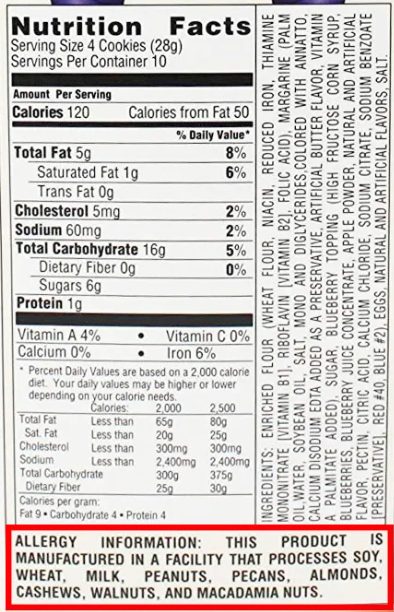
Ingredients are listed in descending order by weight. The first ingredient is the most abundant. If you're avoiding a specific ingredient, scan the entire list, not just the top. I learned early that allergens hide behind names that sound like nothing: "malt vinegar" contains gluten; "casein" is a dairy protein; "albumin" is egg white.
The "Contains" statement
Under FALCPA (the Food Allergen Labeling and Consumer Protection Act), manufacturers are required to declare the presence of the nine major allergens: milk, eggs, fish, shellfish, tree nuts, peanuts, wheat, soybeans, and sesame. Look for a "Contains:" line immediately after the ingredient list.
That line is a real help. I still read the full ingredient list anyway. Both times.
Advisory statements
These are the lines I slow down for. "May contain," "processed in a facility that also processes," and "made on shared equipment with" are voluntary advisory statements. Manufacturers are not legally required to include them. Their absence does not mean a product is free of cross-contact risk. Always check the current package label and, when in doubt, contact the manufacturer directly. I have made that call more times than I can count, and a good company will answer.
What "gluten-free" on a label means
I went gluten-free for my own health, so this one is personal for me too. In the United States, the FDA defines "gluten-free" as containing less than 20 parts per million (ppm) of gluten. Individual sensitivity varies widely. Always check the current package label before consuming any product, as formulations and processes can change.
Read it twice, every time. That habit has carried our family for eighteen years, and it is the one thing I hope you take from this page.